
Table of Contents
Inside the AI Data Centre: The Companies Building Its Infrastructure
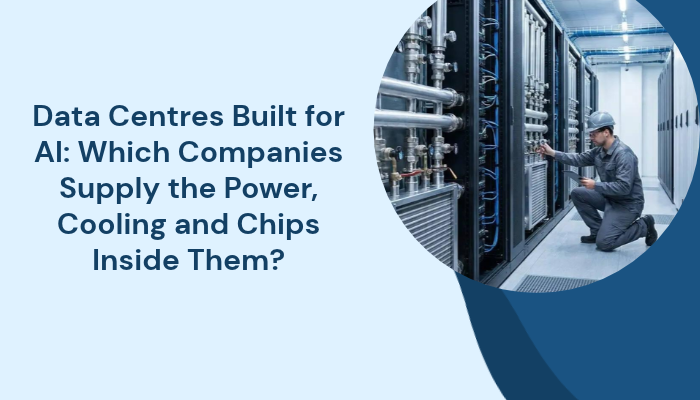
Data Centres for AI: Who Supplies Power, Cooling and Chips?
Data centres reach most people through a local question, namely whether a new facility near their town will raise electricity bills, draw on scarce water or add constant noise, and a Gallup poll conducted in March 2026, as reported by Al Jazeera, found that 71% of Americans oppose establishing AI data centres in their area. These are the effects residents can observe directly, so public searches about data centres centre on approval, opposition and local impact.
A second group reads the same news and asks something else. A developer, a contractor or an equipment buyer needs to know who makes the transformers, switchgear and chillers that every approved site still requires, and that question has a harder answer because lead times for some substation transformers have stretched from roughly 140 weeks in 2023 to more than 160 weeks in 2026, according to Data Center Knowledge. Public opinion therefore shapes where a data centre can be built, and supplier capacity shapes when it can open.
The sections below map the companies behind each layer of data centre infrastructure, from power equipment to cooling, boards and chips, and show how a company description confirms what a supplier actually makes.
What Is an AI Data Centre and How Does It Differ From a Traditional Data Centre?
A data centre houses the servers, storage and networking equipment on which applications run, with the power and cooling that keep them running. An AI data centre trains and runs AI models on accelerated servers, and the electricity and heat each rack produces set it apart. Turner & Townsend, in its 2026 cost index, found that US data centre construction costs rose 13% during 2026 and that AI-ready facilities cost roughly 10% more than traditional ones, which it links to higher rack density, liquid cooling and faster delivery schedules.
| Rack type | Power per rack | Source |
|---|---|---|
| Traditional data centre rack | About 10 kW | IEEE Spectrum, 2026 |
| Average rack across operators, 2026 | 27 kW (16 kW in 2025) | Schneider Electric, July 2026 |
| Newest AI systems such as NVIDIA Vera Rubin | Up to 246 kW | Schneider Electric, July 2026 |
| Planned megawatt-class rack | 1,000 kW | NVIDIA, from 2027 |
Which Companies Build the Infrastructure Inside a Data Centre?
Four groups share the work. Developers and operators acquire land and grid capacity and rent the finished space, as EdgeCore did in Reno and as TeraWulf plans to do with a Kentucky campus set to be leased to Anthropic. Contractors build the halls, and only 26% of North American respondents in the Turner & Townsend survey considered regional contractor capacity sufficient. Equipment suppliers provide power, cooling and hardware, and software tenants rent the capacity once it is live.
Trade shows group suppliers by domain, so an exhibitor list for a utility show, a clean energy show or a semiconductor show already sorts companies into the layers of a data centre build. Each exhibitor record pairs a short capability description with the website, employee size, headquarters address and booth number, which shows whether a company builds hardware, advises or sells software.
| Layer | What it supplies | Matching event | Example companies from event descriptions |
|---|---|---|---|
| Grid planning | Power system studies and advice | DISTRIBUTECH Atlanta utility show, 1 to 4 March 2027 | EnerNex |
| Power equipment | Switchboards, cable, storage, on site generation | RE+ Las Vegas clean energy show, 16 to 19 November 2026 | EPEC Solutions, Southwire, FlexGen, PROENERGY |
| Cooling | Coldplates, coolant distribution units, access floors | Data Center World Nashville data centre show, 24 to 27 May 2027 | CoolIT Systems, Delta Electronics, ASM Modular Systems |
| Boards and materials | HDI boards, IC substrates, precious metals | International Electronics Circuit Exhibition, Shenzhen, 2 to 4 December 2026 | Heraeus Precious Metals |
| Chip tools | Thin film deposition systems | SEMICON Korea Seoul semiconductor show, 17 to 19 February 2027 | Evatec AG |
| Software tenants | Cloud data and Kubernetes software | AWS re:Invent Las Vegas cloud show, 30 November to 4 December 2026 | Databricks, Fairwinds |
The searchable events directory covers exhibitors, dates and venues for upcoming shows.
Also read- Value Chain Analysis With Trade Show Exhibitor Lists
Why Do Power Equipment Suppliers Set the Schedule of a Data Centre?
Electrical equipment is a small share of the budget and a large share of the delay. Bloomberg reporting, cited by Russell Investments, puts electrical infrastructure below 10% of total data centre cost, yet the whole project can stall when that part of the supply chain slips.
| Equipment | Lead time | Source |
|---|---|---|
| Substation transformers | About 140 weeks in 2023, more than 160 weeks in 2026 | Data Center Knowledge |
| Switchgear | Closer to one year | Data Center Knowledge |
Demand explains the pressure. Data Center Knowledge projects the US data centre electrical equipment market growing from about $20 billion in 2026 to $65 billion by 2030, and grid access adds a gate of its own, since 56% of respondents in the Turner & Townsend survey described power as a significant barrier.
Planning firms work at the start of that process. EnerNex, listed for DISTRIBUTECH, describes itself as an energy consulting and engineering firm focused on power systems, smart grid technologies and renewable energy integration, and buyers can find similar grid planning and utility engineering firms in the DISTRIBUTECH exhibitor records.
Equipment makers appear in the RE+ power equipment exhibitors. EPEC Solutions produces UL 891 classified low voltage switchboards (UL 891 is the safety standard for switchboards) and modular power distribution systems for renewable energy and data centre customers. Southwire supplies utility cable, metal clad cable and engineered wire solutions. FlexGen integrates energy storage hardware with its HybridOS energy management software. PROENERGY is vertically integrated, so one group covers engineering, equipment manufacturing, power plant construction, power agreements and turbine maintenance around aeroderivative gas turbines that supply electricity at peak hours and where renewable generation falls short.
Rising rack density is also moving suppliers towards 800 volt direct current (VDC) distribution. Vertiv began commercialising its 800 VDC portfolio in the second half of 2026 with a deployment ramp through 2027, and its PowerDirect 5000 sidecar delivers 400 kW to 900 kW into the compute. IEEE Spectrum reports that Delta has released 800 V DC in row power racks of 660 kW. Product terms such as 800 VDC, sidecar and power rack therefore mark a supplier working on the current generation of equipment.
Who Supplies Cooling for AI Data Centres?
Air cooling reaches its limit at roughly 30 kW to 40 kW per rack, according to TechTarget, and the newest AI racks draw several times that. Direct to chip liquid cooling closes the gap by attaching cold plates to CPUs and GPUs so that a circulating liquid carries the heat away, and TechTarget adds that immersion cooling suits loads above 100 kW per rack.
CoolIT Systems, founded in 2001 and headquartered in Calgary, makes direct liquid cooling products, namely coldplates, coolant distribution units (CDUs) and rack level systems. Delta Electronics describes a specialisation in power and thermal management together with energy efficient products, which places the company in the power and the cooling layers at once. ASM Modular Systems, a subsidiary of Kingspan Group, supplies access floors for data centre and office markets. Both appear in the Data Center World cooling and power exhibitors, the most direct place to search for a cold plate or coolant distribution unit.
Who Makes the Circuit Boards and Chips Inside an AI Data Centre?
This layer covers the suppliers one step upstream of chipmakers, namely boards, substrates, materials and tools, because those are the companies that appear in event descriptions. The International Electronics Circuit Exhibition, taking place at the Shenzhen World Exhibition & Convention Center from 2 to 4 December 2026, describes coverage of high density interconnect (HDI) boards, IC substrates, package substrates and advanced materials for high speed and high-frequency use. Heraeus Precious Metals, one of its listed companies, describes a business that spans trading precious metals, making products from them and recycling, which marks it as a materials supplier and a different kind of company from a board maker.
SEMICON Korea takes place at COEX in Seoul from 17 to 19 February 2027. Evatec AG, a Swiss manufacturer among the SEMICON Korea semiconductor equipment exhibitors, makes thin film deposition systems using physical vapour deposition, sputtering and evaporation for semiconductor, advanced packaging and optoelectronics customers, and high-performance computing appears among the applications in its description. Its machines serve chip and packaging plants, so the tool maker sells to chipmakers and packaging firms and has no direct contact with data centre operators. Suppliers in these two shows can be filtered by exhibitor headquarters country to separate Chinese, Korean and European sources.
Also read- Electronics Manufacturers: Seven Types and What Each Makes
Are Cloud and AI Software Companies Part of Data Centre Infrastructure?
They rent the capacity and do not build it. The AWS re:Invent cloud software exhibitors include Databricks, which describes a cloud native data intelligence and AI platform running across AWS, Azure and Google Cloud, and Fairwinds, which describes software for securing and managing Kubernetes infrastructure. Every company on such a list sells software, so a power or cooling supplier can set it aside, and a software vendor targeting companies that create AI workloads can start with the attendee lists for IT and Technology events.
How Can a Company Description Show What a Data Centre Supplier Actually Makes?
Four checks turn a short description into a reading of capability.
| Check | Example | What it tells a buyer |
|---|---|---|
| A product noun | Switchboards, coldplates, cable, access floors | Names the product. Sector phrases such as electrification and automation (ABB) or complete connection solutions (Belden) cover several layers, so the product categories on the company website need a look. |
| A named standard or process | UL 891 (EPEC), physical vapor deposition (Evatec) | Points to hands on manufacturing. |
| The main verb | Southwire makes cable, EnerNex advises on power systems, FlexGen integrates software with storage hardware | Separates the maker, the adviser and the integrator. |
| The phrase vertically integrated | PROENERGY | Signals one group covering several stages, which suits a buyer who wants a single contract across more than one stage. |
How Can Buyers Build a Shortlist of Data Centre Suppliers in Three Steps?
- Identify the layer from the product noun in the description: power, cooling, boards, chips or software.
- Open the exhibitor list for the event category that holds that layer, such as Power & Energy events or the Electric & Electronics group in the industry wise event categories, and filter by the same product noun. The exhibitor lists on Exhibitors Data carry the fields shown in the examples above, and the how we work page explains how those records are compiled.
- Confirm the result on the company’s own website before any outreach.
Frequently Asked Questions
How much electricity does an AI data centre use?
The International Energy Agency (IEA) states in its 2025 Energy and AI report that a typical AI focused data centre consumes as much electricity as 100,000 households and that the largest facilities under construction will consume 20 times as much.
Does an AI data centre use a lot of water?
CNBC reports that most large AI data centres use closed loop liquid cooling, which uses very little water each day, while dry cooling uses far less water than evaporative cooling and can require far more electricity in hot climates.
What is the difference between enterprise, colocation and hyperscale data centres?
The IEA separates enterprise data centres owned by the organisations that use them, colocation facilities where tenants rent space, and hyperscale facilities run by the largest cloud providers. CNBC describes Equinix as a colocation operator that supplies the power, network connections and cooling for tenants who run their own server racks.
What is 800 VDC and why do AI data centres need it?
NVIDIA states that traditional 54 VDC distribution was designed for kilowatt scale racks and that a 1 MW rack on it could need up to 200 kg of copper busbar, so NVIDIA is moving to 800 VDC distribution for 1 MW racks starting in 2027.
Why are some regions limiting new data centres?
In November 2026 the Loudoun County Board of Supervisors in Virginia voted to pause Board action on legislative data centre and electrical substation applications for up to 12 months, retroactive to 15 September. The County Attorney advised that a blanket moratorium on all data centre approvals is not legal, so administrative applications continue. TechTarget reported in 2026 that Norway had slowed its AI data centre boom over grid concerns.

Value Chain Analysis With Trade Show Exhibitor Lists
Who Makes What Inside a Value Chain? How Trade Show Exhibitors Reveal the Companies at Each Stage Value chain analysis became popular because it breaks a product down into the steps that add value from raw material to...