
Table of Contents
How to Build a Market Entry Strategy Without Wasting Resources

When a company is considering a new market, the starting point of any solid Market Entry Strategy is often the total size of that market. How much does the industry spend in that country? How fast is it growing? How many companies are already operating there? The number might be in the hundreds of millions, but that does not automatically mean there are hundreds of millions worth of opportunities for your business. Once you narrow the market by location, company type, buyer fit and existing competition, the number of realistic prospects can look very different. The number that matters is how many companies you can realistically sell to and is often calculated much later, sometimes after the expansion budget has already been approved.
This is where the problem starts. A business can approve a budget based on a large market opportunity, only for the sales team to later find that there are far fewer suitable accounts to target than expected. The eight checks below build a real account count using data most teams can already pull, before that budget gets signed off.
The Problem: What’s Going Wrong?
Many business expansions receive approval through three primary factors; the overall number of customers in a market, the total amount by which an industry will grow over time, and the competitive forces within a given marketplace. When combined together, these can be strong indicators of whether or not a company should expand into a particular market. However, none of those factors can identify how many businesses in a market can realistically sell whatever it is that your company offers. This lack of insight also applies to start-ups with funding.
CB Insights analysed 431 VC-backed start-ups that shut down and found that 43% failed due to poor product-market fit. That was more than any other single cause of failure (CB Insights).
Part of the problem is simply how these decisions get made. The real account count usually becomes clear later, once sales teams start speaking to potential buyers. Sometimes, they find far fewer relevant companies than the original plan assumed. By that point, the budget has already been approved.
The Solution: How to Fix It
Eight checks replace that size estimate with an evidence-based plan.
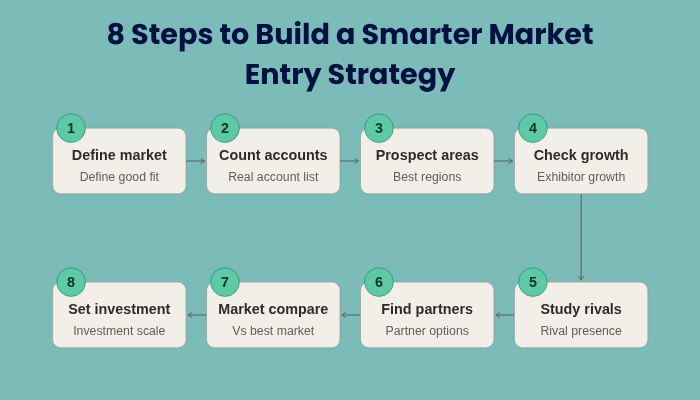
Step 1: Define Your Target Market
Before looking at a country, define exactly what a good prospect looks like. Consider the industry, company size, business model, buyer roles and the problem your product solves. If this part is vague, the account count will be vague too.
Step 2: Count Qualified Accounts in the New Market
There’s no need to rely on a rough market estimate when there are better ways to determine how many possible customers there may be. Attendee lists from events that you’ve attended will provide you with actual company names, attendees’ job titles and locations; filter this by your target customer (from step one) and you’ll have a list of actual companies which is much easier to count then just assuming that all of the businesses in the industry would be interested.
If you get fewer than 50 good prospects from the process described above, I recommend going back to steps five and six to see if you can improve the situation if the number of prospects appears to be very small compared to other competitors, then you may want to stop here and start looking elsewhere.
Also read- The Rise of Buying Groups at B2B Trade Shows
Step 3: Identify Where Your Prospect Companies Are Located
You should now be looking at your prospect company locations. It may be that your best opportunities for sales are in just one or two geographic areas. If so, it makes more sense to test these initial areas before trying to cover the whole market at once.
Step 4: Determine if There Is Still Growth in the Market by Looking at Trade Show Exhibitors
The size of an industry (account count) will tell you how large the industry is. However, this does not necessarily mean the industry is growing. This can be determined by comparing the number of trade show exhibitors from the previous two or three events in that area.
Also read- How to Choose the Right B2B Trade Shows in 2026: A Selection Checklist
Step 5: Analyse Competitors in the New Market
Exhibitor list data for the same show returns each competing company’s name, booth size, and years exhibiting. The exhibitor list can also help you identify companies that already have an established presence in the market. If the same few competitors appear repeatedly and have a strong presence at major industry events, it is worth looking more closely at how established they are before finalising the expansion plan.
Step 6: Find Partners for Market Entry
A partner conversation started before launch can shorten the time to a first deal in a market where the business has no existing reputation, which makes each complementary vendor’s name and category worth pulling into a conversation to have before finalizing the go-to-market strategy. Look for distributors, resellers, integrators or other complementary businesses that already work with the type of customers you want to reach.
Step 7: Compare the New Market Against Your Best Existing Market
Now compare the new market with one of your strongest existing markets, using the lists built in Steps 2, 4, 5, and 6, for a side-by-side comparison built on real numbers. To get the “not already served by a competitor” row, remove any company from the Step 2 account list that also appears on the Step 5 competitor list.
| Market Signal | Existing Market | Candidate Market |
|---|---|---|
| Exhibitor count, last two editions | From Step 4 | From Step 4 |
| Qualified accounts | From Step 2 | From Step 2 |
| Accounts not already served by a competitor | From Steps 2 and 5 | From Steps 2 and 5 |
| Competitors holding majority of accounts | From Step 5 | From Step 5 |
| Identified partner candidates | From Step 6 | From Step 6 |
The comparison will show where the new market looks stronger and where it raises questions. Those weaker areas are the ones worth investigating before approving the budget.
Step 8: Size the Market Entry Investment
Now you can use the comparisons to evaluate what level of involvement in the new market is justified. When a candidate market has high ratings for most entries in the table, it would be good to go ahead with a full-scale development plan. In the case where the opportunities look very similar across most categories, you could develop your business smaller and then see if the potential exists in the marketplace.
The eight steps above run on two data sources: attendee data and exhibitor data for the market under consideration. Attendee data supplies the account list in Step 2. Exhibitor data supplies the competitor and partner lists in Steps 5 and 6, and the same trade show calendar filtered by industry or country support Steps 3 and 4.
ExhibitorsData supplies attendee and exhibitor data together, with documentation on how the data gets verified worth reviewing before either list goes into a budget conversation.
Also read- How to Get Verified Exhibitor Contacts in Minutes with Smart List Builder
Common Mistakes to Avoid
Confusing market size with the number of potential customers. A large market does not automatically mean there are enough companies that are a good fit for your business.
Expanding across an entire country too soon. Your potential customers may be concentrated in a few regions, making a focused launch a better starting point.
Ignoring existing competition. Knowing how many potential accounts exist is not enough. You also need to know who is already competing for them.
Looking only at the market today. Current account numbers do not show whether market activity is growing, stable or declining.
How Does This Replace A Single Market Size Estimate?
Although a market size estimate may be valuable for showing the scope of an industry and whether it’s worth looking into, you should not use it as one of your main reasons to fund a new market expansion budget.
There are eight additional measurements (checks) that will provide you with other data points to examine prior to deciding if the funding will be used. How many suitable businesses exist? Where are they based? Will growth occur in this market? Has anyone else created a business in the area? Are there possible partners?
Using all these answers together will allow you to have a better idea of how entering the market could potentially affect your business.
Where Do You Get This Data For Your Next Market Entry?
Pull attendee and exhibitor data for the market under consideration and run it through Steps 1 through 8 before the next budget number gets proposed. Explore ExhibitorsData to build that account list before the next market entry budget goes to approval.
Frequently Asked Questions
How is trade show attendee data different from exhibitor data?
Attendee data lists the people and companies visiting an event, which is what Step 2 uses to build a qualified account list. Exhibitor data lists the companies that paid for a booth, which is what Steps 5 and 6 use for competitor and partner research. Same event, two different lists, two different jobs.
Can trade show data ever be used instead of conducting a complete market analysis?
Yes. Trade show data provides information about the companies currently active in a specific industry or segment at this moment. However, it does NOT provide confirmation for the regulatory feasibility, the product/segment match (product/market fit), or the overall demand in the target market. Therefore, Steps 1, 7, and 8 use the trade show data as part of the process by pairing it with a formalised description of your target market and an analysis of your proposed market compared to an established market prior to making any budgetary decisions.
What if a target market has no relevant trade shows?
A thin or nonexistent trade show calendar in a category is itself worth noting. It can mean an early-stage market with little organized commercial activity yet, or simply a category that doesn’t organize around events. Either way, more weight shifts onto Steps 1, 2, and 7.
Is a qualified account count under 50 always a reason to skip a market?
Not on its own. Step 2 treats it as a signal to run Steps 5 and 6 next. A thin account list with little competition can still support a focused entry, while the same count against three entrenched competitors usually can’t.
How often does trade show attendee and exhibitor data get updated?
This varies by event and by data provider. Check the update frequency before relying on any data set for a market entry decision, since a list built from an event three editions old will undercount a market that has grown since.
How many editions of a trade show should get checked before deciding?
Comparing exhibitor and attendee counts across the last two or three editions of a market’s main event, as Step 4 does, is usually enough to see whether activity is growing, flat, or shrinking.

AI Sales Prospecting with Event Data: What Changes?
AI Sales Prospecting with vs Without Event Intelligence AI sales tools now handle a large share of a B2B rep's working day: the account list is ranked before the first meeting, the sequence is drafted before the...