
Table of Contents
How to Dominate WHX and WHX Labs 2026 Like a Pro
Executive Summary / Key Takeaways:
- 12% increase in pavilion space for Germany, China, and Korea at WHX and WHX Labs 2026 signals market dominance
- 30% increase in dual-presence exhibitors shows scaling from R&D to commercialisation
- Multi-region exhibitor tracking reveals strategic intent and market priorities
- Focus on repeat exhibitors, dual-presence companies, and verified C-level contacts for actionable insights
Most healthcare organisations don’t only exhibit at events once; they exhibit time and again – sometimes even in different countries around the world, which helps you to realise that there’s much more to strategy than simply getting your name out there via booth and badge displays. The repetition in the B2B exhibition is not random.
In many cases, we tend to view trade shows romantically; you read about “the energy” that exists on the floor, “the innovations” displayed on the stands, and the countless number of badges being scanned, but if you’re honest with yourself, that is all just background noise. What truly matters is why the same 400+ companies continue to appear year after year under the WHX Exhibitor List umbrella in regions around the globe.
Once you begin to see World Health Expo as a dataset rather than simply an event, everything changes. The placement of each booth location, the repetition of companies appearing at each event, and the countries that a company chooses to participate in all signal strategy. This is about recognising what direction the market is going in before others take notice of it. Companies such as ETKHO, who consistently participate in various locations around the world using WHX as a platform to showcase their advanced hospital engineering systems, represent a long-term commitment to the Middle East region. The question remains…
Why do companies show up to every event?
As we look at the WHX 2026–2027 roadmap, it is simple to get confused between the WHX 2026–2027 roadmap and a travel itinerary. The roadmap lists WHX Dubai in February, WHX Labs, and WHX Tech in the Middle East. Then there are the African cities: Lagos, Nairobi, Johannesburg, and Cape Town. Miami in the Americas. And finally, the Asian cities: Osaka, Bangkok, and Kuala Lumpur.
All of these include Arab Health (Arab Health Attendees List), Medlab Middle East (Medlab Middle East Attendees List), Asia Health, and Thrive by WHX, along with WHX Labs and WHX Tech. With all events falling under the WHX umbrella, it is essential to recognise the common branding when examining repeat exhibitors.
For example, Givas appears at WHX Labs multiple times over several years. Each year allows them to compare buyer priorities from the UAE against European trends, enables them to position their products correctly and strengthens existing relationships with distributors. Their consistent participation is a prime example of how multi-year attendance at trade shows represents strategy, not coincidence.
What actually matters when you start paying attention
Forget about vanity metrics. While 4800 exhibitors may seem like a lot, the true numbers lie within the pavilions. According to the 2026 data, Germany, China and Korea have increased their dedicated pavilion space by 12% compared to previous years. They are not taking tentative steps to test the waters; they are making bold statements claiming dominance in specific product areas and markets.
Additionally, the labs versus clinical halls are becoming intertwined. As Arab Health and Medlab are now being branded as WHX Dubai and WHX Labs, respectively, they are expected to feature over 4,800 exhibitors and attract more than 270,000 healthcare professionals from around the world, underscoring the sheer scale of this ecosystem. However, “intertwined” doesn’t mean “under one roof.” In a major shift for 2026, WHX Dubai moves to the Dubai Exhibition Centre (DEC) at Expo City, while WHX Labs remains at the Dubai World Trade Centre (DWTC).
Also read: Corporate Event Planning: The Ultimate 2025 Guide
CuraMedical, a Dutch supplier of absorbable haemostats, was able to leverage their dual presence to create strategic partnerships and remain visible in the long run. These types of companies are not only developing new technologies; they are also expanding their offerings to hospitals and clinical markets.
Which companies are really setting the pace
While exhibitions themselves may not be indicators of future markets, exhibitors are. Repetition tells the story. An Osaka MedTech company attends WHX Labs Dubai, then WHX Labs Bangkok, and WHX Labs Nairobi in a few short months. The company has broadcast its roadmap for expansion for everyone to see.
Another example is the combined booth of the Northern German Healthcare Association at WHX Dubai, which has allowed companies from Hamburg and Schleswig-Holstein to access markets in the Gulf region, build political and commercial connections, and do it all over two-plus decades. Regional strategy and market positioning matter much more than an individual product launch, and understanding these patterns can provide valuable information.
Identifying patterns, without having to walk every aisle
Data sets are messy; thousands of names with very little usable data is just noise. Precise identification is important, and that is where Exhibitors Data provides value. When you look for:
- Companies that are Regional Repeaters (have attended multiple WHX events)
- Companies that are Dual-Presence Exhibitors (exhibiting in both clinical and lab halls)
- Companies with Verified C-Level Contacts (you know who makes decisions for them)
- Companies with Full Insights (including LinkedIn URL, social media, firmographic data, product categories, and specific event participation)
Identifying the correct exhibitors will help analysts and researchers determine market focus, expansion plans, and partnership opportunities. Do not manually scrape thousands of names – use verified WHX 2026 Exhibitor Intelligence to filter C-level contacts and regional repeaters in seconds.
Also read: How an Accurate Event Attendees List Can Maximize Your ROI
Different regions tell different stories
All WHX events are not the same. Dubai is the place to go for clinical and lab technologies, Lagos and Nairobi show emerging markets, Bangkok and Osaka indicate APAC expansion, and Miami is where North American activity consolidates. This includes previously known events such as Arab Health, Medlab Middle East, Asia Health, and Thrive by WHX. Looking at how exhibitor presence varies by region will give you an idea of who is expanding, what technologies are moving fastest, and where competition is increasing.
| Region | Relative Scale | What the Exhibitor Pattern Signals |
| Dubai | Largest WHX hub | Clinical and lab convergence, global anchor market |
| Miami | Medium | North American consolidation and partner visibility |
| Bangkok | Medium | APAC market entry and technology adoption |
| Nairobi | Emerging | Early-stage regional engagement and distribution testing |
| Osaka | Focused | R&D visibility and selective commercial expansion |
What this means for your research strategy
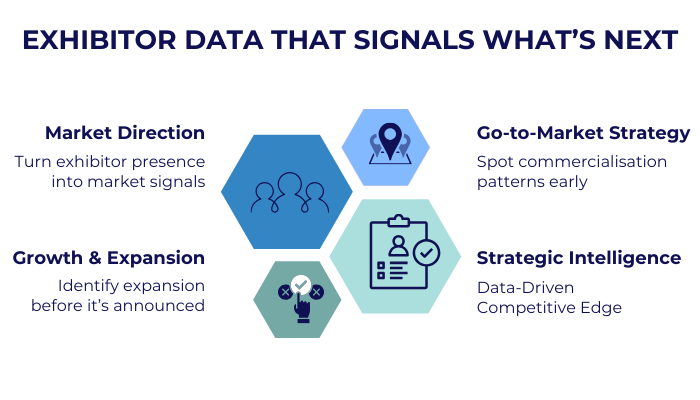
- Identify repeat exhibitors first – when an exhibitor shows up at multiple locations, it is a clear indicator of intent.
- Follow dual-presence exhibitors, which will provide information regarding how a company structures its product lines and scales offerings.
- Analyse company data – C-level contacts, LinkedIn profiles and product categories will indicate leadership focus. Repeat exhibitors like ETKHO, Givas, and CuraMedical demonstrate how repeat participation provides actionable insights into buyer behaviour and market priorities.
- Prioritise high-value targets using Exhibitors Data with verified and detailed company data.
- Contextualise all of this information – the combination of pavilion expansion, multi-region repetition, and dual-presence forms a predictive map of where the market is going.
Follow the signals
Track repeat exhibitors, dual-presence patterns, and the detailed company insights found within Exhibitors Data. Each time an exhibitor repeats an appearance, expands a pavilion, or moves from one region to another, it is a signal indicating the direction of strategic focus. Analysts who decipher these signals can prioritise time efficiently, gain an understanding of market focus, and react before their competition even realises.
Some of the loudest signals in healthcare expansion are usually never communicated through press releases. Pavilion changes, dual-hall presences, and repeated multi-region appearances are the real signs of growth. WHX Dubai and WHX Labs are not just trade shows; they are scoreboards. Instead of focusing on the flashy presentation left by an exhibitor, focus on the exhibitor who leaves a footprint behind.
The Final Takeaway
To successfully navigate WHX and WHX Labs 2026:
-
-
- Track repeat exhibitors to determine market priorities.
- Watch for dual-presence exhibitors to understand commercialisation strategies.
- Map the multi-regional expansion of exhibitors to predict areas of future strategic focus.
- Analyse company data to gain insight into leadership, products, and market strategies.
- View exhibitor data as a living source of actionable intelligence (WHX Labs Exhibitor List).
-
The path has already been drawn. Exhibitors have already placed breadcrumbs along the way. Follow those breadcrumbs closely, listen to the signals, and enter WHX 2026 and WHX Labs with the clarity, insight, and confidence needed to succeed.

Where to Find Trade Show Attendee Lists: 2026 Strategy Guide
Where to Find Attendee Lists for Trade Shows and Conferences (2026 Guide) Finding attendee lists for trade shows and conferences is one of the first things businesses try to do before committing time and budget...