
Table of Contents
How to Choose the Right B2B Trade Shows in 2026: A Selection Checklist
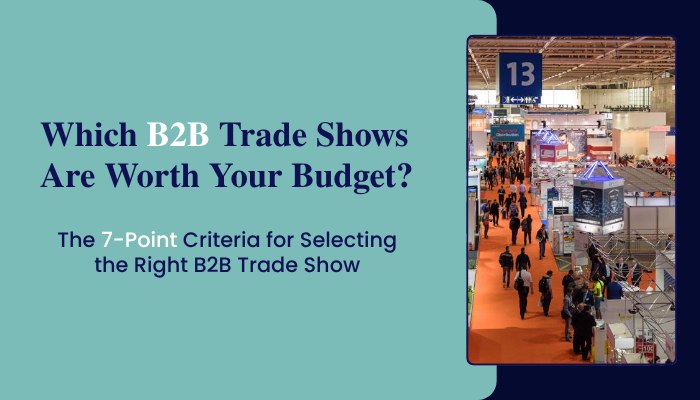
A trade show can have 20,000 attendees and still be the wrong event for your sales team. The question before signing the contract is whether the people you need to reach will actually be there.
According to CEIR’s 2026 Marketing Spend Decision Report, today nearly 41 percent of an exhibitor’s total marketing budget is being spent on B2B trade shows. In addition, according to the report, nearly two-thirds (64%) of those who exhibited at a trade show ranked the quality of attendees over the number of attendees as their primary criteria when selecting a trade show. Using event selection criteria that align with the needs of your current customers, potential new customers, or targetable buyers, and using these in the evaluation process to determine which events will drive your sales pipeline, are best practices.
The B2B Trade Show Selection Checklist
Use six criteria to assess every B2B trade show before you commit budget: audience, industry, geography, buying committee reach, competitive relevance, and commercial value.
| Criteria | Key Question | What To Check |
|---|---|---|
| Audience fit | Are your target buyers attending? | Attendee job titles, seniority, and company profiles |
| Industry fit | Does the event match your industry? | Show focus, exhibitor list, session tracks |
| Geographic fit | Does the audience come from your target markets? | Attendee and exhibitor countries of origin |
| Buying committee reach | Does the event reach your buying committee? | Functions represented: procurement, IT, finance, operations |
| Competitive relevance | Who are you competing against? | Direct competitors, adjacent vendors, potential partners |
| Commercial value | Does the event make commercial sense? | Expected pipeline against total program cost |
1. Are Your Target Buyers Attending?
Total attendance doesn’t tell you whether an event can reach your target buyers. Check the job functions, seniority levels, and company types represented among attendees before using attendance figures in a selection decision.
Verified attendee data for a given event shows exactly who registered in past years, so this check draws on actual attendance records from those past editions.
Also read- What Can You Do With Exhibitor and Attendee Data Before a Trade Show?
2. Does The Event Match Your Industry?
Compare the event’s stated industry focus with the industries your sales team actually targets. Then check whether the exhibitor base includes companies selling to the same buyer groups you sell to.
A show listed under IT and technology events, for example, tells you more about its actual audience than a show that markets itself as broadly “B2B” or “enterprise” with no defined vertical. Industry-specific event listings cover other verticals the same way, which makes this comparison faster across a long list of candidate shows.
3. Does The Audience Come From Your Target Markets?
The host city describes where an event happens. Attendee origin is a separate data point worth checking on its own, since show branding and actual attendee origin don’t always line up. Review attendee and exhibitor country data before treating any event as reaching a specific region.
Filtering a trade show directory by country makes this checkable before travel and booth costs get committed.
4. Does The Event Reach Your Buying Committee?
A large event can bring in the right industry, but it does not guarantee that you are reaching out to all the people who will be involved with the purchase. Look at whether the attendee list is made up of many of the typical roles that are often found on a purchasing team, such as procurement, operations, IT, finance, etc., other than just your defined buyer personas. In most B2B purchasing decisions, there are multiple stakeholders (committee members), and an event that covers only one of these groups gives you insight into what part of this decision-making committee your event has reached.
5. Who Are You Competing Against?
The exhibitor list helps you assess whether an event is commercially relevant to your category. Look for direct competitors, complementary vendors, and companies serving the same buyer groups. A strong competitor presence is a useful signal that the event matters to your category. Confirm it against attendee quality data too, since exhibitor presence on its own doesn’t prove buyer intent.
Exhibitor list data for a target show reveals that picture in advance, which also shapes how a booth’s messaging gets positioned once the show opens.
Also read- How to Get Verified Exhibitor Contacts in Minutes with Smart List Builder
6. Does The Event Make Commercial Sense?
A workable estimate begins with the pipeline:
Expected pipeline = qualified opportunities × average opportunity value
Build that opportunity count from:
• Priority accounts likely to attend
• Meetings or conversations realistically achievable at the booth
• Your historical qualification rate for event-sourced leads
• Your historical rate of turning a qualified lead into an opportunity
Multiply that opportunity count by average opportunity value to get an expected pipeline figure. Compare that figure against the full cost of attending, booth and sponsorship fees, travel, staff time, pre-event promotion, and follow-up, to calculate an ROI estimate grounded in your own numbers. Pipeline is the sales value an event could generate. ROI measures what that value cost to produce.
How event data is sourced and verified is worth reviewing before building this estimate on top of any third-party attendee numbers, since the formula is only as reliable as the inputs feeding it.
Also read- How B2B Trade Shows Fit Into Commercial Orchestration?
Go, Compare, Or Skip: How To Score The Event
| Verdict | Signals |
|---|---|
| Go |
Target buyers are clearly represented in attendee data Industry matches your ideal customer profile Geography matches an expansion or coverage goal Relevant competitors and category vendors attend Expected pipeline covers the total event cost |
| Compare further |
One or more of the checks above still needs more data before it’s a clear pass or fail Audience looks relevant but buyer seniority or function mix is unclear Industry and geography fit but the commercial case still needs validation |
| Skip |
Buyer or industry fit is weak Geography doesn’t support the business objective Event economics don’t work even under realistic assumptions |
How To Build Your 2026 B2B Trade Show Shortlist
Start with a broad event list, filter it by industry and geography, and apply the six criteria above only to the events that already match your market. A B2B trade show calendar is a practical starting point for that first filter, narrowing a long list down to candidates worth scoring in detail.
Teams that want help running this process can use ExhibitorsData’s consultancy services to shortlist and evaluate events on their behalf. ExhibitorsData provides the attendee, exhibitor, and event data behind every check-in in this list, so a go, compare, or skip decision comes from actual records for each event.
Wishing you successful and strategic event marketing!
Frequently Asked Questions
How do you choose the right B2B trade show for your business?
Score each candidate show against audience fit, industry fit, geographic fit, buying committee reach, competitive relevance, and commercial value, then compare results across shows before committing budget.
What’s the most important factor in trade show selection?
Attendee quality. Exhibitors surveyed for CEIR’s 2026 research ranked it above attendance volume and most other selection criteria.
How many B2B trade shows should a company attend per year?
There’s no fixed number. A shorter list of well-matched shows that pass this checklist consistently produces stronger pipeline results than a longer list chosen mainly by size or reputation.
How do you estimate trade show ROI before attending?
First estimate expected pipeline: qualified opportunities multiplied by average opportunity value. Then compare that pipeline estimate against the full cost of attending to arrive at an ROI figure. The two numbers measure different things, and both matter before committing budget.
For questions on data coverage and update frequency, ExhibitorsData’s FAQ page covers those details directly.

AI Sales Prospecting with Event Data: What Changes?
AI Sales Prospecting with vs Without Event Intelligence AI sales tools now handle a large share of a B2B rep's working day: the account list is ranked before the first meeting, the sequence is drafted before the...