
Table of Contents
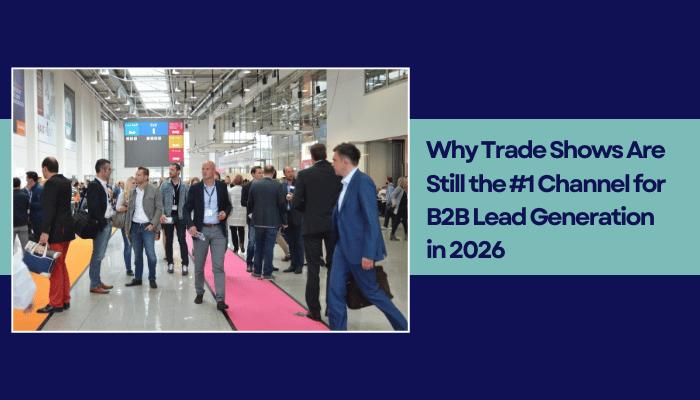
Why Trade Shows Are Still the #1 Channel for B2B Lead Generation in 2026
Why Trade Shows Are Still the #1 Channel for B2B Lead Generation in 2026
B2B lead generation in 2026 has a cold email problem. The average response rate hit around 4% last year, not conversion, not interest, 4% reply, including the “please remove me from your list” ones.
Run the numbers. Five hundred emails, a full week of prospecting, twenty replies, fifteen negative. Five people are willing to have a conversation.
Meanwhile, in Las Vegas last October, 17,000 people showed up to IMEX America and paid to be there. They booked flights and cleared calendars. 4,700 were hosted buyers who sat through 90,000 pre-scheduled one-on-one meetings in three days. People who asked to be sold to.
The cold email rep and the IMEX exhibitor are selling into the same market. One of them is grinding through a spreadsheet of 500 names on a Tuesday. The other just had coffee with the VP who was already going to buy.
How B2B Buyers Research Vendors Before Talking to Sales
Four in ten buyers already know who they want by the time the RFP lands in your inbox. The rest of the process, the demos, the pricing calls, the slide decks… confirmation theatre. You are auditioning for a role that was already cast before you knew auditions were open.
92% of B2B buyers already have a vendor in mind before the formal evaluation process begins. 41% have already selected their preferred vendor before the first sales call happens. (Forrester, 2024)
The average B2B buying committee involves 8.2 stakeholders. If a buyer is comparing three vendors, each one gets a sliver of the committee’s collective attention. That sliver is competing against a decision that was already half-formed before you entered it.
Cold email reply rates dropped from 6.8% in 2023 to below 5% in 2025. LinkedIn connection requests from strangers get accepted about as often as a Friday afternoon proposal email gets a reply. The average cost to generate a single real sales conversation, not a lead but an actual conversation, crossed $1,000 through digital channels, counting outreach volume, response rates, and meetings booked from first touch to calendar invite.
The buyer who stopped replying to cold email did not stop buying. They are still at the conference. And when they get there, the conversion numbers are not even close.
Trade Show Leads vs Digital Leads: Which Converts Better?
Trade show lead generation converts at a rate that makes most digital programs look like a rounding error.
| Channel | Entry Point | Close Rate | Avg. Sales Cycle |
|---|---|---|---|
| Trade show / conference | Registered, paid to attend | 5–15% lead to revenue | ~4 months |
| B2B website | Anonymous visitor | 1.8% to any lead | 8–12 months |
| Cold email | Interrupted outreach | 4% reply, ~0.5% to meeting | 8–12 months |
| Webinar / content | Downloaded, maybe curious | 2–5% MQL to close | 6–10 months |
Website to MQL at 31%. MQL to SQL at 13%. Multiply those out and you are celebrating a 0.07% conversion rate from visitor to closed deal, a number that would embarrass any other business model if someone said it out loud in a board meeting.
Events are the only channel in B2B where the buyer spends their own money to be in front of you. They paid the registration fee, expensed the flight, booked the hotel. No other marketing channel has ever figured out how to get the prospect to pay to be sold to.
The reason those conversion rates are so different comes down to what the buyer was doing in the months before they walked in.
What Buyers Usually Do Before Visiting a Booth
A VP of Operations at a mid-sized logistics company has been quietly dealing with a warehouse management problem for four months. She built a spreadsheet comparing three vendors. Watched demos on YouTube. Called two former colleagues to ask what solution they had used. Read G2 reviews for lunch, and even had a conversation with a consultant friend
Your CRM showed zero activity. No lead score. No intent signal. Invisible to every sales sequence targeting her space.
Then she registered for a supply chain conference.
She is not there to be educated. The shortlist already exists. She is there to see how the vendor responds to a legitimate question with a little heat applied. Does the vendor pull out a phone to check something? Does the vendor actually know the answer? That is the entire RFP.
The companies that win her deal did not win it by outspending on LinkedIn. They won it by being in the room. The companies that lost it sent her a follow-up sequence on the same day she landed in the city where they could have just met her.
Also read- Global Trade: The Gulf’s Risky yet Massive New Heart
Events vs Cold Outreach: Comparing B2B Lead Generation Results
Most teams debate the event budget without actually running the numbers. So here they are.
The digital math:
100 cold emails per week
4% reply rate = 4 conversations
One of those, maybe, becomes a real sales conversation
Over 12 months = 52 serious sales conversations per year
The event math:
One well-chosen trade show
Prepared exhibitor, pre-scheduled meetings
IMEX America 2025: focused exhibitors reported 30-50 qualified conversations over 3 days
Result = 30 conversations in 72 hours
A buyer traveling to a conference to solve a problem will typically close within four months while a buyer interrupted through cold calling on a Tuesday will typically close within eight months… or even at all. Momencio’s research from over twenty major U.S. B2B events has shown that exhibitors who have done their homework prior to arriving at an event, such as researching the attendee list, scheduling meetings in advance, building targeted outreach lists, etc., convert 10 – 15% better than those who just show up.
Event budgets are rarely the issue; however, preparation prior to attending the event nearly always is.
The volume gap between event-based conversations and months of digital follow-up is substantial. However, the bigger question remains why a single event-based conversation with a prospect occurs at a much quicker pace than months of digital follow-up.
Why In-Person Conversations at Events Convert Faster
A buyer who clears their calendar, books a flight, and pays to attend a conference behaves very differently from one who clicked a LinkedIn ad. Every person who met your rep in person becomes someone who vouches for you in the meeting you never get invited to. They are the ones who say “actually, I spoke to them at the conference and they knew exactly what they were talking about” while you are waiting for a callback.
B2B buyers typically go through dozens of interactions before a purchase decision. A 20-minute face-to-face conversation delivers the equivalent of many of those, because the buyer now knows what you look like, how you handle a question under pressure, whether your team actually knows the product, and whether you listened or just pitched. In digital channels, each of those questions will be asked via multiple emails, calls, and meetings that are scheduled weeks down the road. In one event, they all happen in one conversation. Email nurturing for four months is condensed into a single coffee break at an event.
The follow-up email after a real conversation gets opened. The cold one gets archived. Same person. Completely different starting position.
Why Trade Shows Produce Higher-Quality Leads
Booth traffic is the most misleading metric in event marketing. The deals come from the dinner, the roundtable, the 16-person session where someone already knew your problem before you sat down.
| Main Expo Floor | Roundtable Dinner | |
|---|---|---|
| Conversations | 22 pitches in 3 hours | One 3-hour conversation |
| Vendor remembered | 4 out of 22 | The one who knew her timeline |
| Follow-up | Generic blast | Call booked for Tuesday |
| How it started | Random foot traffic | Pre-identified, pre-invited |
Every hour that buyer spends with you is an hour they are not with your competitor. A buyer can read your email while looking at a competitor’s pricing page. When they are sitting across from you at dinner, they are not.
Knowing who is in the room before you arrive is the whole advantage. Trade show attendee targeting turns a show floor into a scheduled series of conversations instead of a lottery. Getting into the right room is half the work. What happens in the 72 hours after you leave is where most companies lose what they earned.
How to Prepare for a Trade Show to Generate Qualified Leads
The difference between a team that comes home with 40 business cards and a team that comes home with 8 real leads worth chasing is decided before anyone boards a plane.
3 weeks before the show:
- Pull the verified attendee list, which companies registered, which titles confirmed
- Filter against your ICP, target the 25-30 accounts worth a conversation
- Research each target: recent news, job changes, announcements, expansion plans. You are looking for one specific hook, a funding round, a new market entry, a public challenge they mentioned, that demonstrates you have done your homework before the conversation even begins.
- Send personalised pre-event outreach, reference something specific, not “looking forward to connecting”
- Book meetings before arrival. The rep who lands with a full calendar is not lucky. They started earlier.
At the show:
- Run your scheduled meetings first. Everything else is bonus.
- End every conversation with a specific next step: a date, a document, a call booked, not “let’s stay in touch”
- Send the follow-up the same evening
Verified event attendee data is what makes step 1 possible. Without it, you are guessing at the right people while your competitor already has meetings booked with them.
The unprepared team scans 200 badges, sends a generic blast, and wonders why events did not deliver ROI. The prepared team boards the flight home Friday with three discovery calls already in next week’s calendar.
How to Follow Up After a Trade Show Without Losing Leads
Momencio’s 2026 data shows response rates drop from 25% within 24 hours to under 8% after 72. The window is the flight home. Not the airport. Not Monday. The conversation ends at 3pm, the email goes at 5pm, and it references something specific, not “great meeting you at the show,” which is what 90% of exhibitors send.
Three conversations happen at every show. Here is what actually works:
① Badge scan. You spoke for two minutes. They were polite. You have their company and title, nothing else. Do not pretend it was more. “We met briefly at [show]. I did not want to waste your time at the booth so I am sending the one resource that is actually relevant: [link]. Worth a 20-minute call if the timing is right.”
② Deep conversation. You had a real exchange. They shared a specific problem. Reference the exact thing they said. “You mentioned the mid-year rollout and the integration issue with your current WMS. Here is the case study for [Client X] who had the same constraint and timeline. I have blocked Tuesday at 2pm if that works.”
③ Competitor’s customer. They told you who they use and why they were looking around. Do not attack the competitor. Acknowledge the switch cost. “Switching from [Competitor] is not a small decision. Here is what the transition actually looked like for [similar company], including the timeline and results.
Also read: How to Stop Wasting Trade Show Leads (and Start Closing Them in Real Time)
Why Events Continue to Deliver the Best B2B Lead Generation Results
A buyer who cleared their calendar, expensed the trip, and flew to a conference tells you something no intent data platform can: they have a problem serious enough to leave the office for. Cold email, LinkedIn outreach, paid search, all the channels that used to surface those buyers, quietly stopped working. The buyers did not.
People saying trade shows are dead, usually are talking about their own experiences of being a exhibitor in an empty space, scanning a bunch of badges for people wanting a free pen; blasting out a generic message on Thursday; and then not hearing anything back. The lack of engagement is not because of trade shows; it is the result of the lack of preparation by the exhibitor.
Events solve the hardest problem in B2B sales: the buyer’s decision happens in private, and events are the only place it becomes visible before it is final.
FAQ’s
Are trade shows still effective for B2B lead generation in 2026?
Yes. Trade shows remain the highest-intent B2B lead generation channel because buyers fund their own attendance. Major shows including IMEX America, RSA, and Web Summit are growing year on year.
What is the ROI of B2B events compared to digital marketing?
Trade shows convert leads to closed revenue at 5-15%, compared to roughly 0.07% end-to-end for digital funnels. Event deals also close in around 4 months versus 8-12 months for cold outreach.
What is it about trade shows that generates B2B sales leads?
Trade show attendees self-qualify themselves. By attending and paying for travel to attend, an attendee is already aware they have an issue they want to solve.
What number of leads should you realistically expect to get from a trade show?
Prepared exhibitors typically report having 30-50 quality conversations with people interested in what your company sells over the course of three days. In comparison, cold outreach will produce approximately 52 leads per year.
Why do conference leads typically close faster than digital leads?
Conference attendees have already developed some level of purchasing intent prior to speaking with you. They have narrowed down their selection of potential vendors to a small list of providers; they have a set budget for the purchase, and they have a time constraint on when they need to make the purchase. Typically, a digital lead does not have these elements established prior to speaking with you.
Do trade shows offer a better way to generate a B2B pipeline than digital marketing?
Yes, for large-dollar-value deals. Trade shows provide opportunities to meet with decision-makers (who may or may not have met you previously) as they are actively considering which vendor(s) they will select. The compressed sales cycle allows for faster approval processes and the in-person interactions you establish build long-term relationships between multiple stakeholders involved in the approval process.
The buyer who stopped replying to your emails did not stop buying. They just stopped being reachable any other way. The sales teams closing more deals are not working harder on digital. They are in the room where the buyers already are.
AI Sales Prospecting with Event Data: What Changes?
AI Sales Prospecting with vs Without Event Intelligence AI sales tools now handle a large share of a B2B rep's working day: the account list is ranked before the first meeting, the sequence is drafted before the...