
Table of Contents
Case Study: Exposing Hidden Brand Owners at WHX Dubai 2026
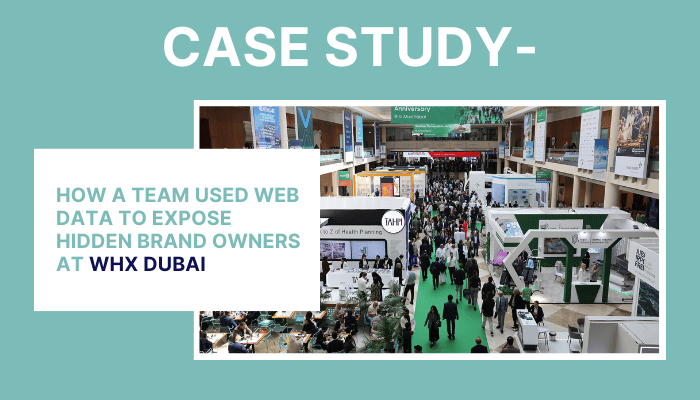
How a team used web data to expose hidden brand owners at WHX Dubai
Before WHX Dubai 2026, a global B2B platform preparing for regional expansion faced a challenge that would have had a significant impact on lead quality and visibility. On the surface, the exhibitor list appeared very basic: hundreds of exhibitors, hundreds of brands, and hundreds of websites.
However, most of the “independent” exhibitors were not actually independent. Some were owned by the same parent company, operating under different names, domains, and positioning. These relationships were not visible in the publicly listed exhibitor directory. If an agreement was made with one partner, there could potentially be conflicting agreements made with three other partners owned by the same parent company. Using Exhibitor Data, the client was able to identify these hidden ownership relationships prior to having any discussions with potential partners.
Client Profile
The client was a B2B platform expanding into the Middle East market using regional channel partnerships. Their regional expansion strategy required them to form non-exclusive regional partnerships with multiple independent companies, ensuring:
- No conflict existed between partners.
- No duplication of territorial coverage existed.
- No hidden restrictions existed due to a common parent company, preventing a breach of exclusivity.
To accomplish this, they needed clarity on which exhibitors were truly independent, which brands shared a common parent, which websites belonged to the same corporate group, and which “competitors” were actually sister companies. All of this information was unavailable within the public WHX Dubai exhibitor list.
Problem
The risk to the client was based on the internal structure of the exhibitor list rather than commercial aspects. At x:
- Multiple exhibitors operated under different brand names but shared the same legal ownership.
- Some exhibitor groups operated separately on the web to appear as independent companies.
- Other groups used regional domain names to conceal their global control.
- Some groups portrayed themselves as competitors during negotiations, even though they were negotiating as one entity.
Unless detected by Exhibitor Data, the client could have signed multiple partners representing the same corporate entity, leading to legal disputes, the inability to negotiate for exclusive rights, and damaged trust before establishing a foothold in the market.
Solution
Exhibitors Data employed company and website intelligence to recreate the true corporate structure behind the exhibitor list. Instead of just filtering contacts, the dataset was analyzed to identify:
- Patterns in shared website ownership.
- Domain registration links between exhibitors.
- Mapping of parent-subsidiary brands.
- Identical legal entities operating under different domains.
- Brand clusters controlled by a single corporate entity.
Each exhibitor was then recategorised as an Independent Entity, Subsidiary Brand, Regional Front Brand, or a Multi-Brand Group. This allowed the client to negotiate exclusively with the corporate group rather than offering conflicting terms to sister brands simultaneously.
Results
- Conflict Prevention: Prevented partnership disputes at the time of the event.
- Accuracy: Prevented the signing of overlapping brands from the same parent group.
- Efficiency: Reduced legal reviews of agreements executed post-event.
- Strategy: Preserved the client’s regional exclusivity strategy with complete ownership transparency.
- Stability: Avoided long-term channel conflicts that usually arise months after a deal is executed.
- Control: The event transitioned from individual brand networking to corporate group-level negotiation control.
Key Takeaways
- Names ≠ Reality: Exhibitor names do not represent corporate reality.
- Invisible Links: Websites often reveal ownership structures that are invisible in public directories.
- Brand vs. Company: Brand count is not equivalent to company count.
- Ownership Visibility: Partnership strategies fail when ownership is invisible.
- Strategic Data: Exhibitor data becomes strategic when it reveals who actually owns the brands on the floor.
Where to Find Trade Show Attendee Lists: 2026 Strategy Guide
Where to Find Attendee Lists for Trade Shows and Conferences (2026 Guide) Finding attendee lists for trade shows and conferences is one of the first things businesses try to do before committing time and budget...