
Table of Contents
Case Study- Interpack Exhibitor Data Cuts 41% Acquisition Risk
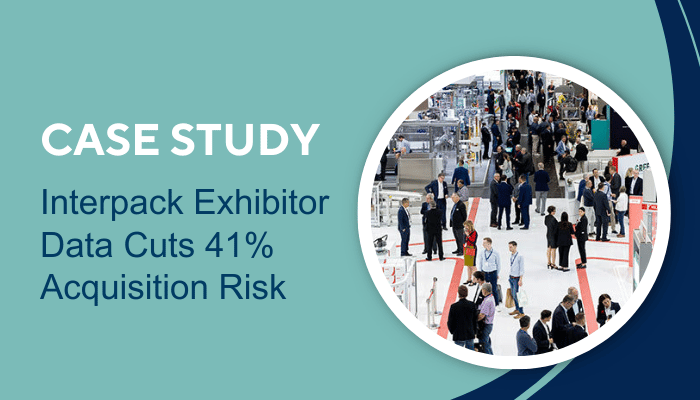
How a Packaging Group Utilised Interpack Exhibitor Data in 2026 to Identify “Ghost Brands” Prior to Acquisitions
Prior to Interpack 2026, a German-based packaging conglomerate identified attractive acquisition targets across Germany, Italy, and Eastern Europe. Early reviews indicated that while there were many attractive exhibitors, most were using longstanding brand names that had been acquired through mergers, asset sales, or other holding structures.
While public exhibitor listings showed products and companies, they did not provide insight into whether the organisations behind those brands were still fully functional. Exhibitor Data allowed the group to look past the branding to see the actual operational reality.
Company Overview
This packaging conglomerate is a mid-market player in the niche materials space, including barrier films, medical-grade wraps, and mono-material laminates. They used Interpack to identify independent manufacturers as acquisition candidates. To begin due diligence, their team required clarity on:
- Whether exhibitors had in-house engineering teams.
- Whether product development was occurring internally or elsewhere.
- Whether the brand represented a standalone organisation or a holding structure.
Challenge
In the packaging industry, legacy brand names are often kept even after the original teams responsible for development and manufacturing have been absorbed by larger organizations. Several exhibitors at Interpack promoted brands that appeared active but actually had:
- No apparent technical personnel.
- No internal roles for product development.
- No operational footprint under the brand itself.
Traditional validation methods were unreliable. Websites were often out-of-date, registry information was delayed by restructuring, and corporate announcements rarely reflected internal team changes. Without visibility, the group risked entering acquisition talks with companies that were no longer viable entities.
Solution
Using Interpack Exhibitor Data, the group evaluated organisational reality through workforce structure. Each exhibitor was analysed for:
- LinkedIn company URLs tied to the brand.
- Active employee counts and role distribution (engineering, production, quality, sales).
- Recent employee profile activity.
- Whether employees were actually listed under a different parent company.
This enabled the group to distinguish between operating manufacturers with intact teams, brands maintained only for marketing, and entities already consolidated into larger organisations. The dataset served as a filter to evaluate the true substance of an organisation.
Results
- Disqualification: 41% of initial candidates were removed as “brand-only” entities.
- Risk Mitigation: Two acquisition processes were canceled before formal due diligence began.
- Efficiency: Capital was directed only toward firms with active technical teams.
- Speed: The time required to complete screening cycles decreased dramatically.
- Safety: Legal and operational risks were minimised.
What was once a guessing game for the packaging group became a controlled acquisition pipeline through the use of Exhibitor Data.
Key Takeaways
- Brand Operation: Brand presence is not indicative of operational presence.
- Structure Reveals Viability: Employee demographics and structure reveal if an organisation is still functional.
- Silent Consolidation: LinkedIn and workforce data can reveal consolidations that aren’t yet public.
- Pre-Due Diligence: Exhibitor data is a strategic tool for evaluating organisational substance before making acquisition moves.
AI Sales Prospecting with Event Data: What Changes?
AI Sales Prospecting with vs Without Event Intelligence AI sales tools now handle a large share of a B2B rep's working day: the account list is ranked before the first meeting, the sequence is drafted before the...