
Table of Contents
Global Trade: The Gulf’s Risky yet Massive New Heart
Executive Summary
- Middle East trade shows 2026 have transitioned into the high-speed engines of a $2.3 trillion GCC economy, where non-oil sectors drive over 70% of growth and global trade shift Middle East is the dominant boardroom theme.
- The rise of the ‘Shadow Expo’ means billions in unseen trade negotiations and private business meetings occur months before ribbon-cutting, making Saudi Arabia MICE market growth the primary vehicle for 2026 expansion.
- Success now requires verified exhibitor data to identify decision makers under one roof, bypassing traditional networking to secure cross-border partnerships through direct exhibitor intelligence.
Why the Gulf is the New Heart of Billion-Dollar Global Trade
The strategic shift toward Middle East trade shows 2026 is already being felt in boardrooms from New York to Shanghai.
Crunch time for Saudi Arabia as financial elite descend on Riyadh’ — Reuters
‘In Saudi Arabia’s Trillion-Dollar Building Boom, Chinese Contractors Are in Demand’ — The Wall Street Journal
‘MENA startup funding hits $3.5 billion in September 2025’ — Bloomberg
You’ve probably seen the headlines about the financial elite descending on Riyadh and the trillion-dollar building boom attracting Chinese contractors. Middle East trade shows 2026 are no longer just regionally-based detours; they are becoming the high-speed engines of a $2.3 trillion GCC economy.
Non-oil sectors are driving well over 70% of growth and that’s a fact that can’t be denied. While politics does matter – it influences only in terms of how it affects business – the influence certainly plays a role; however, the vast majority of all of the reports do not tell you anything about the actual action taking place on the ground. It is the reason why global trade shift Middle East is a phrase that you will hear in almost every boardroom this year.
Making you wonder what, exactly, is being negotiated behind closed doors.
Recent exhibition cycles in Riyadh and Dubai have seen sold out show floors, an increase in the number of international pavilions, and a significant rise in the number of first-time global exhibitors Middle East events. The regional sidestep that was once viewed as a central hub for global trade is now viewed as that very same central hub. You see the unseen trade negotiations happening in real time and if you look closely, you see the real money flowing in the ‘Shadow Expo’ where the meetings take place below the surface.
The bright lights shine down on the pavilions, while in the private lounge, billions of dollars worth of deals are often made three months prior to the ribbon-cutting ceremony. These private business meetings and exhibitions are where the true scale of the Middle East MICE industry is revealed. If you’re attending solely to observe and understand what is happening, then you’re simply observing the replay of a game that has been played for months. That realisation creates a sudden and intense pressure to completely re-evaluate your entire annual plan and use the Saudi Arabia MICE market growth as your primary means of expanding in 2026.
How to Prepare for Middle East Trade Shows
Why go to five different cities when you can meet all of the right partners in one week? Be honest – MICE was traditionally just a check-box for meetings and incentives and conferences and exhibitions where you would attend solely to show face. Today, that model is obsolete.
The UAE and Saudi Arabia have turned these platforms into powerful engines that drive business opportunities in Saudi exhibitions and Dubai business events industry projects, providing cross-border partnerships with significant weight.
| Feature | Dubai (UAE) | Riyadh (KSA) |
| Market Role | Global Launchpad & Logistics Hub | Industrial Giga-Project Epicentre |
| Growth Forecast | 8.96% CAGR (reaching $9.26B) | 10.93% CAGR (reaching $5.33B) |
| Strategic Focus | Re-export, Fintech, Tourism | Vision 2030, Manufacturing, Defense |
| Key 2026 Venues | Dubai World Trade Centre (DWTC) | Riyadh Front Expo & RICEC |
| Dominant Sector | F&B, Aviation, Luxury Trade | Construction, AI, Green Energy |
The Middle East is growing exponentially. For last year alone, the Dubai exhibition market analysis shows the sector grew by 25%, with hundreds of millions in economic value created. Saudi Arabia exhibitions 2026 continue to scale even faster under the Vision 2030 business impact initiative to develop venues filled with energy and strategically positioned for momentum. Each handshake has the potential to represent a new multi-regional expansion, and each event represents less of a trade show and more of a high-stakes arena where decision makers under one roof drive change throughout industries.
However, the real ‘ghost’ in the room is the fear that your greatest competitor might get there before you.
Silent Risk: Leaving an Empty Chair at the Table
We refer to a specific type of pressure in today’s markets as the risk of the sidelines. We’ve observed it happen to a manufacturing sector that was slow to take part in entering into the Dubai Hub; in that short period of time, over 40 percent of the sector’s regional market share disappeared to a quicker Asian competitor.
Being on the floor at these exhibitions in the Gulf is not solely about making sales, but also signals to your global competitors, partners, and investors that your company is visionary enough to stake its claim to the available space prior to the doors closing forever.
This is about the architecture of long-term growth in the Middle East as the global trade hub transitions from an oil-based economy to a human-based global logistics economy. This is why international trade corridors in the Middle East are now being drawn through these very exhibition halls; therefore, you need to determine your Middle East trade shows ROI prior to the calendar becoming full.
You need to be truthful about your own readiness for this change before you commit your 2026 budget.
Middle East Readiness Scorecard
- Do you have a ‘Shadow List’? (Names and website addresses of the companies that will exhibit)
- Are your contacts directly sourced? (First and last names plus exact job title of the people in the room)
- Are your leads actionable? (Confirmed professional email addresses and confirmed LinkedIn profiles)
If you were able to check off less than 2 of the above items, you are currently stepping onto the floor blindly without the benefit of verified exhibitor data.
The clock is ticking and the evidence of the future of global exhibitions is right in front of you if you know where to look.
Observe hotel lead times: Where the relocation of an entire industry begins
If you are seeking a true insider tip, observe the hotel lead times for late 2026 in Riyadh. When the Four Seasons sells out 18 months in advance, you won’t be looking at a conference anymore; you’ll be looking at the relocation of an entire global industry.
Trade isn’t simply relocating physically; it is relocating conceptually as Riyadh international exhibitions host technology showcases and international summits that are equal to or greater than any western platform. Those who control the exhibitor intelligence and the flow of verified exhibitor data are rewriting everything we thought we knew about power.
A tech-founder recently advised us that they signed two deals within a span of three days in Dubai that would have required them to fly back and forth between London and New York for three months. That is the fulcrum effect of utilising a single point of contact to move a large amount of global weight through high decision-maker density.
Depending on your seat in the boardroom, this intelligence can completely change your strategy:
- The Tech-Founder: No longer spends his time cold-calling and instead maps the LinkedIn profiles of the key stakeholders that are actually in the room at Dubai trade shows 2026.
- The Manufacturer: Utilises verified company websites and direct email addresses of exhibitors to identify the distributors that are already active in the region.
- The Sales Director: Deploys a new stream of verified job titles and professional business emails to meet that 2X growth target without wasting time on dead booth numbers.
It is enough to give any decision-maker a combination of adrenaline and curiosity to see where global deals really happen.
The Gulf: The Epicentre of International Trade
Exhibitions in Saudi Arabia and Dubai trade shows 2026 are not only catching up, they are creating new ways in which international trade takes place. Trade is no longer limited to New York, London, or Shanghai; trade is now taking place where ambitions meet the ability to deliver and where global buyer attendance is at an all-time high.
The stage of world trade is the skyline of Riyadh and the exhibition halls of Dubai. The Gulf is no longer a stop along the way; today, the Gulf is a fulcrum. If you pay attention to the signals, it is clear. The stage is set and the deals are being made. The next question is: Where will you stand when the music stops?
Key Takeaway
If you have plans to enter into or grow your business within this region, the first step is to secure the competitive intelligence that your competition is currently using to win.
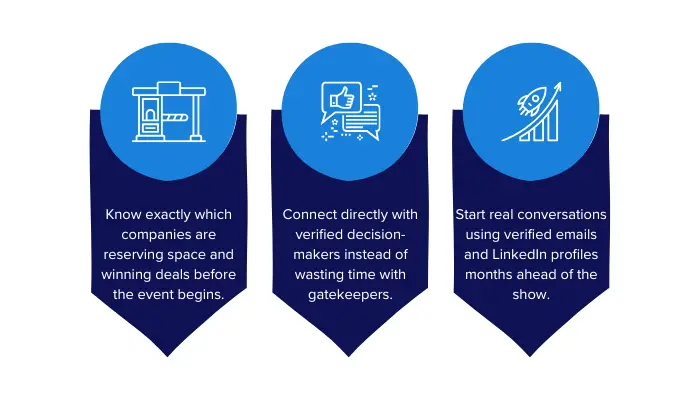
- Determine Your Competition: Examine the verified list of Companies and Websites for each of the 2026 show cycles to identify who is actually reserving space.
- Locate the Decision Makers: Utilise direct Names and Job Titles to bypass gatekeepers and connect directly with the decision makers making deals at the “Shadow Expo.”
- Engage Directly: Send them verified Business Email and LinkedIn Profile(s) to start a conversation three months prior to the event commences.
Obtain a sample of the Middle East trade shows 2026 dataset – including all six core intelligence fields – and see how much of a difference there is between attending an event versus having the room.
Frequently Asked Questions
- Why are Saudi Arabia and Dubai important for global trade?
They are the anchor points for the India-Middle East-Europe Economic Corridor (IMEC). With over $1 trillion in active development projects, the region is becoming the world’s largest procurement hub for Tech, Energy, Construction, and other industries. - Are Middle East trade shows worth attending?
Yes, however, the benefit is changing. Unlike traditional markets which focus on networking, Gulf exhibitions are high-intent deal-making environments. Attendees come with the authority to approve and sign multiple million-dollar contracts at the show. - What is the MICE industry in the Middle East?
The MICE (Meeting, Incentive, Convention and Event) industry is the engine of the region’s non-oil economy. In Saudi Arabia, it is forecasted to reach $5.33 billion by 2030 at a CAGR of 10.93%, driven by mega-venues and global events. - How big is the exhibition market in Saudi Arabia?
The market is scaling rapidly under Vision 2030. The growth is fueled by the expansion of the Riyadh Front Exhibition & Conference Center and the relocation of mega events such as LEAP and the World Defense Show to Saudi Arabia. - What are the top trade shows in Dubai and Riyadh?
LEAP (Apr.), Gulfood (Feb.), Middle East Energy (Apr.), and Big 5 Construct Saudi (Jan.) are some of the major events on the 2026 calendar. These events are expanding venue sizes at places like the Dubai Exhibition Centre to accommodate record-breaking global attendance.

AI Sales Prospecting with Event Data: What Changes?
AI Sales Prospecting with vs Without Event Intelligence AI sales tools now handle a large share of a B2B rep's working day: the account list is ranked before the first meeting, the sequence is drafted before the...