
Table of Contents
How Exhibitor Data Exposes Emerging Trends in HealthTech and FinTech

Where the First Clues Usually Appear
There is a strange blind spot in the way companies try to understand the market, especially in healthtech & fintech. They take time to read all of the analyst reports, subscription dashboards, competitive decks, and industry forecasts to find the trends in their industry. They use sentiment analysis, they scrape job postings, and they build keyword war rooms so they look intelligent. In spite of all of this, they are completely overlooking the easiest and least glamorous, but most obvious, source of information as to where their industry is headed. Two years ago, an Indian startup quietly launched an AI-powered hospital-billing platform. Today it processes hundreds of crores in claims, showing how early moves reveal structural shifts. And that source is exhibitor data. Simply by looking at which companies are choosing to exhibit at events such as HLTH, HIMSS and Money20/20, gives you a better idea of where your industry is heading than with many of the strategy tools everyone thinks they love.
Call it too obvious. Call it boring. All of these are fine. Markets are rarely elegant; they leave a footprint long before they leave a headline.
Most people still view Exhibitor Lists as simply a list of logistics (Who is getting which booth? Who is sponsoring what? Who is providing the embarrassing tote bag?). But SmartHealth PayCard showed that even patient-facing finance is being tested quietly at conferences before mainstream awareness. People do not recognise that exhibitors self-select into the future they believe exists. Companies that book booths at events such as CES or Web Summit are not exhibiting there just to decorate. They are placing bets on their products. They are signalling what they are building and who they intend to sell it to. This single act transforms exhibitor data into one of the first true predictive indicators of impending market shifts.
When Patterns Start Repeating, the Market Starts Revealing
And here is where the gap widens. Analysts talk about trends once the momentum is visible. Reporters talk about trends once the funding follows. Investors talk about trends once everyone else is chasing the same deals. Exhibitors move long before any of that. They appear months before their category even has a name. They show up because they smell a structural change, and they want to be the first ones in the room when it hits.
This is why exhibitor behaviour is not noise. It is a signal that gives away where the next two years of HealthTech and FinTech are secretly headed. Care.fi and Cedar demonstrate that healthcare and finance are no longer separate worlds. Companies are combining patient billing, insurance processing, and cash-flow management with fintech-style efficiency. Even a specialised fintech tool like SmartHealth PayCard is now enabling patients to manage medical expenses in ways that were previously impossible, showing the early footprints of structural change.
When Category Density Becomes a Forecast
Look at HealthTech, for example. If you track exhibitor patterns at HIMSS and HLTH over the last three years, something interesting starts to appear. The biggest rise is coming from AI-enhanced clinical tools, not the broad AI hype everyone has memorised, but the hyper-specific workflow modules. Companies building AI triage systems. Companies building decision support layers that sit inside EHR platforms. Exhibitors like Subtle Medical, Aidoc, and Echo IQ, focusing on AI-assisted imaging and clinical workflows, repeatedly appear year after year, highlighting how early density in these niche categories foreshadows broader industry adoption. Companies are building real-time patient monitoring beyond telehealth. These exhibitors quietly place themselves in front of the buyers who drive adoption. When you see the density of exhibitors in these categories rise year after year, you do not need a consultancy whitepaper to tell you what is coming. You can see it on the floor.
There is also a different pattern emerging in HealthTech. The companies returning to events after disappearing for a year or two are not coming back with the same identity. They are coming back with rebrands that point to a shift from point solutions to platform strategies. And that shift shows itself first as a growth of new exhibitor lists, long before the industry can begin to repeat the “platform” story. Clinical operations automation exhibitors are exploding at events like Medica. Although their categories are loosely defined, their numbers grow with each show cycle. This is an example of how early structural changes are exposed by exhibitor data, which reports will only formalise much later. The same story is unfolding in Dubai, Florida, Singapore and everywhere else.
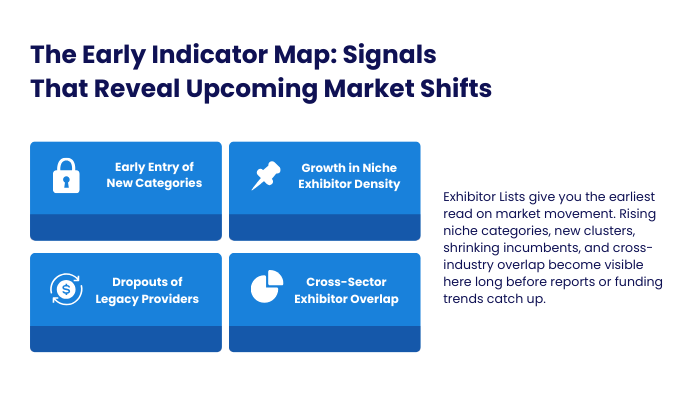
It is easier to see the FinTech movement with exhibitor data, since FinTech exhibitors tend to be more aggressive, impatient and restless than HealthTech exhibitors. I have walked through Money20/20 and FinTech Surge Festival, and it has jumped right out at me. Fraud prevention firms lag, while real-time payment infrastructure grows more prominent. The embedded finance platforms are clustering around banking software providers. As the years go by and you continue to map the exhibitor lists, it is becoming increasingly clear that FinTech is entering a new stage in which the real innovation is occurring at the infrastructure level. There is also a decline that most people miss. Traditional banking tech exhibitors are shrinking or dropping out. And this tells you something about where the sector is heading. As incumbent firms pull back from the floor of exhibitions and smaller infrastructure vendors rush in to fill the voids left by those incumbent firms, that is when we can see the balance of power within an ecosystem begin to shift. That power is not reflected in current funding graphs; however, it is reflected in the number of vendors at exhibitions. Once again, by the time the general public becomes aware of the power shift through the media, savvy players will have long since established relationships (through partnering) and expanded products as a result of reading the early signals.
The Emerging Convergence Between HealthTech and FinTech
One of the most fascinating aspects of this phenomenon is the convergence of the HealthTech and FinTech industries. The exhibit data reflects a blurring of lines across categories that would have seemed unlikely just a few years ago. At Insurtech Connect, you now see HealthTech billing automation startups exhibiting alongside payment processors. At HIMSS, you see digital identity verification firms from the FinTech space taking an interest due to hospitals’ reimbursement fraud and compliance challenges. At Money20/20, you see well-being-based credit score firms testing their models on actual partners. Exhibit data shows these industries quietly intermingling. Payments and healthcare will eventually converge; the exhibit data merely points out the rate at which it is happening is greater than was anticipated. Care.fi and Cedar are combining hospital billing with fintech-style payment platforms. M-TIBA in Kenya allows patients to manage medical payments through mobile wallets, while India’s Affordplan provides instalment-based hospital financing. These exhibitors reveal that cross-industry integration is already underway.
The Booth Map Always Knows More Than Investor Reports
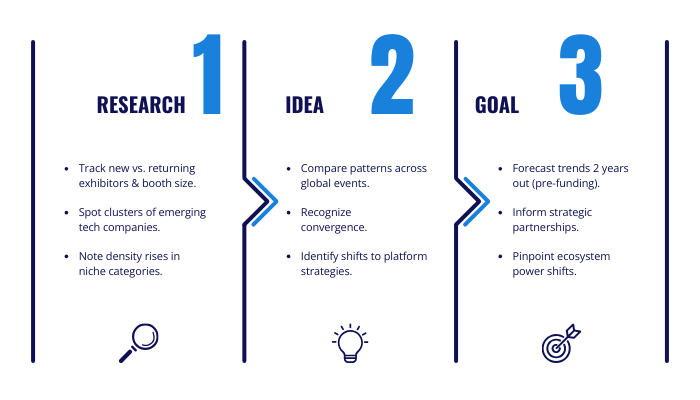
Learning to read exhibitor data requires a tiny shift in thinking. You do not look at names. You look at patterns. You look at returning exhibitors and whether their square footage has changed. You look at first-time exhibitors and whether they cluster around a technology that is still emerging. You look at which categories have more newcomers than returning players. You look at the dropouts and ask why they backed out. You track the categories that are expanding in every major event across continents. It feels simple when you describe it. Insight lies in the repetition of patterns, not individual data points. Once you decode the movement inside a single event, you start comparing it to the movement inside another event. And that is how you forecast.
There is a real-world case study that proves this. Two years before the AI diagnostic wave exploded in funding, HIMSS exhibitor lists were already showing a spike in startups offering AI-assisted imaging interpretation. It looked random at the time. It looked like a weird pocket of companies doing something too niche. But these exhibitors were early signals. They kept returning to the same events. They kept increasing their presence. And eventually, the category went mainstream, and the funding followed. Anyone who analysed the exhibitor lists early could have predicted the wave long before headlines or funding.
Why Exhibitor Data Deserves a Front-Row Seat in Your Strategy
That is why exhibitor information needs to be included in every strategy presentation in 2025. Not a nice-to-have, but an integral intelligence source. Exhibitor information provides you with the earliest indications of movement in a market, well before it is apparent. It reveals to you the categories that are increasing and the categories that are decreasing. It also tells you who is entering your market and who has quietly exited. It will show you where the next strategic partnerships are likely to appear. It will indicate to you what technology is ready to move from concept to acceptance. You are not using a crystal ball to predict the future; you are reading a list that the entire industry inadvertently shares.
Deciding to ignore exhibitor information can no longer be viewed as a neutral decision. Ignoring exhibitor data leaves you reacting too late. Markets move too fast for passive behaviour; early movers gain the advantage while others wait. Exhibitor data is one of those early signs. And it will keep exposing emerging trends for anyone willing to see them before the rest of the world catches up.
AI Sales Prospecting with Event Data: What Changes?
AI Sales Prospecting with vs Without Event Intelligence AI sales tools now handle a large share of a B2B rep's working day: the account list is ranked before the first meeting, the sequence is drafted before the...